
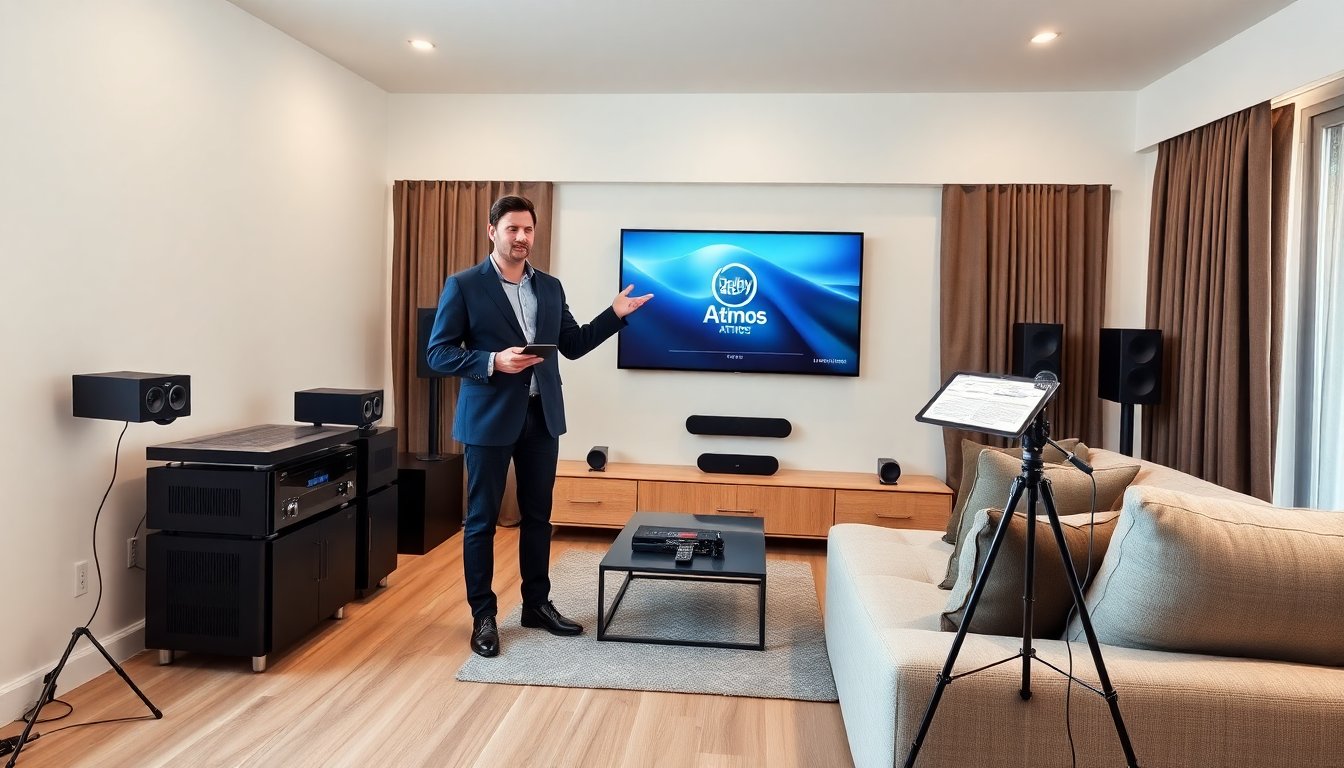
dolby atmosphere speakers create a three-dimensional sound field in a living room. They move sound as objects instead of fixed channels. This change gives listeners height, depth, and precise placement of sounds. The guide explains how dolby atmosphere speakers work, how they differ from regular surrounds, and how to pick a setup for a room.
Key Takeaways
- Dolby Atmos speakers create an immersive 3D sound experience by using object-based audio and height channels to place sounds precisely around and above the listener.
- Unlike traditional surround sound systems, Dolby Atmos delivers dynamic sound movement and overhead effects by decoding metadata and adapting placement through a renderer.
- Choosing the right Dolby Atmos speaker setup depends on room size, ceiling height, and budget, with options ranging from soundbars with upward-firing drivers to full AVR systems with discrete height speakers.
- Proper speaker placement and receiver calibration are essential for optimal Dolby Atmos performance and accurate sound localization in the listening environment.
- Dolby Atmos systems require compatible source material and receivers that support Atmos decoding and multiple height channels to fully benefit from the technology.
- Room acoustics, such as floor type and wall treatments, significantly impact the clarity and effectiveness of Dolby Atmos speakers, so consider these when setting up.
How Dolby Atmos Speakers Work: Object‑Based Sound And Height Channels
Dolby Atmos speakers use object-based audio to place sounds in three dimensions. An audio object carries position data and sound. The playback system reads that data and sends signals to speakers that match the object position. The system uses height channels to add vertical placement. Height channels sit above the listener or reflect off the ceiling. The setup can include in-ceiling speakers, upward-firing modules, or speakers with built-in height drivers. A receiver or processor decodes the Atmos mix and maps objects to the available speakers. The speaker layout and room size affect how accurately the system places objects. Sound engineers can assign dozens of objects in a single scene. The renderer in the receiver adapts the scene to the installed speakers. The renderer also applies panning and level adjustments to mimic distance and movement. When the mix uses overhead elements, listeners hear helicopters, rainfall, or overhead effects as if they are above them. The result gives a sense of space around and above the listener. This outcome differs from older channel-based systems that only fixed sounds to fixed speakers. Dolby Atmos speakers require compatible source material, such as Atmos Blu-rays, streaming tracks with Atmos, or game content with Atmos metadata. The receiver or soundbar must support Atmos decoding and object rendering. Many modern AV receivers include Dolby Atmos decoding and support for multiple height channels. Soundbars may use upward-firing drivers to simulate height for smaller rooms. The placement and calibration steps help the system map object locations to the physical speakers. Proper calibration improves localization and prevents holes in the sound field.
What Makes Atmos Speakers Different From Traditional Surrounds
Traditional surround systems use fixed channels like 5.1 or 7.1 to place sound. Each channel sends audio to a specific speaker. Atmos systems add height channels and object control. This change gives Atmos systems more precise localization. A sound can move along a path instead of jumping between speakers. Atmos mixes include metadata that defines object position and movement. Receivers decode the metadata and place sound accordingly. Traditional systems rely on channel count only. Atmos systems rely on object metadata and a renderer. Atmos speakers also change speaker roles. A rear speaker can act as a height speaker if the renderer assigns an object above the listener. The result gives a fuller and more natural soundstage. Listeners report clearer overhead effects and better movement of sound. Many films and games now include Atmos tracks. Streaming services deliver Atmos content when the network and subscription allow it. Content with Atmos metadata gives the speaker setup material to show its advantage. Without Atmos source material, Atmos speakers still play stereo and surround content normally. The setup hence offers backward compatibility with older formats.
Choosing The Right Dolby Atmos Speaker Setup For Your Room
The room size and budget affect which dolby atmosphere speakers fit best. Small rooms benefit from a soundbar with upward-firing drivers. Medium and large rooms benefit from a full AVR with discrete height speakers. The listener should measure distance and ceiling height before buying. Low ceilings can reduce the effect of upward-firing modules. High ceilings may require in-ceiling speakers for clear height effects. The receiver must support the speaker count the listener plans to use. Common layouts include 5.1.2, 5.1.4, and 7.1.4. The last digit shows the number of height channels. A 5.1.2 layout uses two height channels. A 5.1.4 layout uses four height channels for better overhead detail. Receivers list supported configurations in their specs. The listener should match speaker power and impedance to the receiver ratings.
Placement Tips, Receiver Compatibility, And Budget Options
Place front left and right speakers at ear height and angled toward the listener. Place the center speaker directly under or above the screen. Place surround speakers slightly behind the listening position. Place height speakers above the front and rear listening areas or use upward-firing modules on top of front speakers. When using in-ceiling speakers, place them slightly in front of the listening position for movie seats. The listener should run the receiver’s auto-calibration and then fine-tune levels and distance manually. Check that the receiver decodes Dolby Atmos and supports the planned speaker layout. Verify HDMI inputs support the video formats in use. Many budget options use a Dolby Atmos soundbar with virtual height processing. Mid-range options include an AV receiver with a 5.1.2 speaker kit. High-end setups use discrete floor-standing speakers and in-ceiling drivers with a multi-channel AVR. The listener should choose speakers that match room acoustic traits. Hard floors reflect sound and may benefit from rugs. Thick curtains reduce reflections and improve clarity. Wall treatments can improve midrange and bass response. The listener should listen to sample Atmos content before final purchase when possible. Demo tracks with clear overhead cues help evaluate height performance. Budget choices can still give immersive effects. Upward-firing drivers work well in many rooms. In-ceiling speakers give the most direct height image when installation is possible. The listener should balance cost, aesthetics, and installation effort when choosing dolby atmosphere speakers.